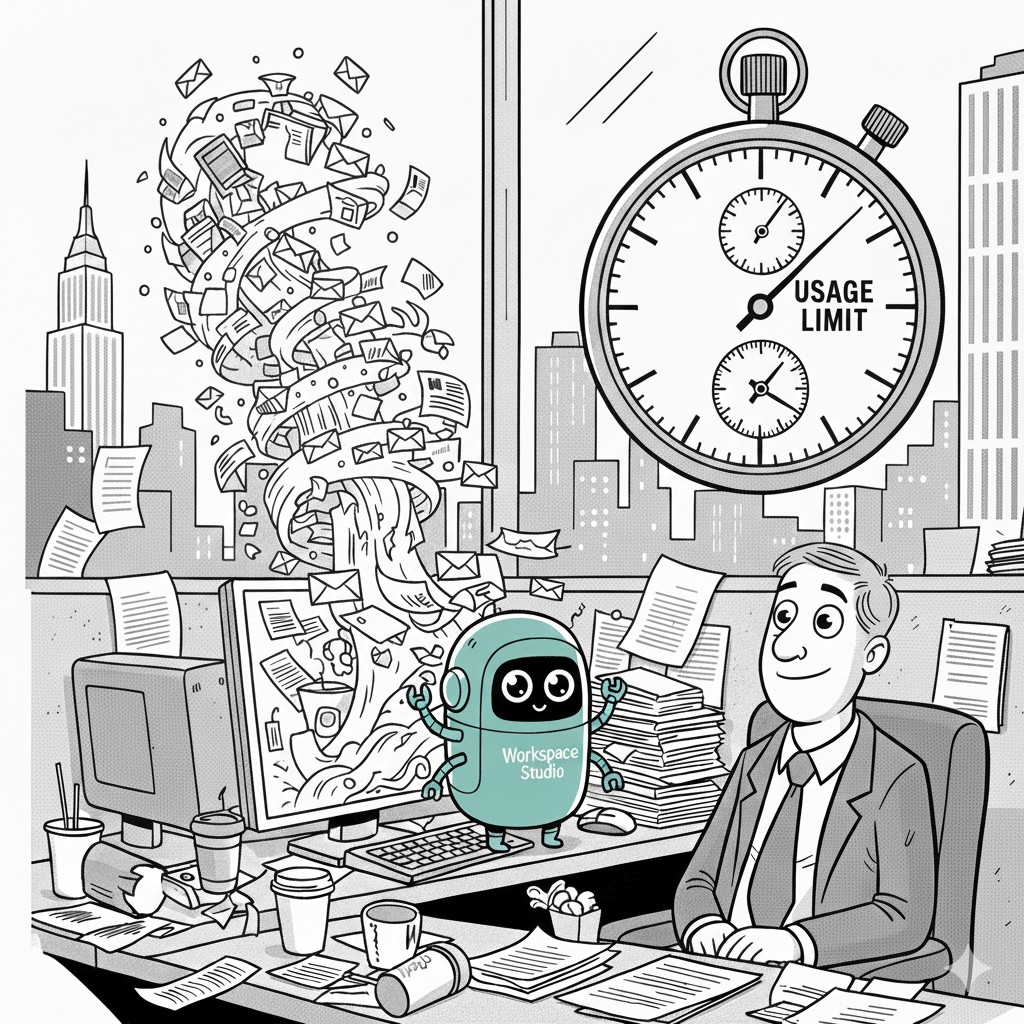
Google Released Workspace Studio
How Google's new Gemini 3-powered, no-code platform puts intelligent AI agents into the hands of every employee to automate complex workflows across the entire Workspace environment.
Google has officially released the general availability of Workspace Studio, a groundbreaking platform engineered to manage, design, and distribute sophisticated AI agents directly within the Workspace environment. Launched beginning December 3, 2025, the platform redefines productivity by allowing non-specialist employees, or "domain experts," to build complex workflow solutions using only natural language. Powered by Gemini 3's advanced reasoning, agents automate routine work across Gmail, Drive, and Chat. While high usage limits are currently promotional, final per-user limits and pricing are expected in January 2026, demanding urgent enterprise attention.
Introduction and Market Context
Workspace Studio addresses the significant digital friction caused by repetitive, low-value tasks that rigid, previous automation systems failed to capture. Google’s design strategy deliberately shifts the control of automation creation directly into the hands of the everyday user. The release began rolling out on December 3, 2025, with a staggered approach: Rapid Release customers gained access immediately, while Scheduled Release domains will follow starting January 5, 2026.
Technological Foundation and Features
Workspace Studio agents leverage Gemini 3's advanced reasoning and multimodal comprehension to interpret context and purpose, dynamically solving complex, multi-step business problems across the integrated Workspace ecosystem. The core feature is the no-code interface, where users deploy agents by simply describing objectives in plain language. For instance, a user can command, "If an email contains a question for me, label the email as 'To respond' and send me a notification in Chat." This conversational method has shown potential to reduce manual planning time substantially in initial trials, with early programs completing over 20 million tasks. Critical data governance ensures user inputs are not used to train the underlying AI models, and the system maintains security via a Zero Trust framework.
Market Positioning and Commercial Unknowns
The debut of Workspace Studio intensifies competition with platforms like Microsoft’s Copilot, where Google’s advantage lies in embedding agent creation directly into the core productivity applications used by billions. By offering intelligent, no-code workflow creation, the platform also directly challenges the traditional Robotic Process Automation, or RPA, market. Despite the broad availability across most Workspace editions, the long-term cost is the most pressing commercial factor. Technology leaders must prioritize contractual negotiations to secure clear terms on scalability and usage limits before Google publishes its permanent pricing structure in early 2026.